
United Baristas has been exploring the carbon emissions of a cup of coffee over the past five years. More recently we’ve focused on identifying the viable actions baristas and coffee businesses can make to tackle their carbon emissions.
Our founder Tim Ridley has also been involved in an industry project to scope the carbon emissions of coffee shops. In this short presentation at Caffè Culture 2022, he maps United Baristas’ journey exploring coffee’s carbon footprint and brings it up-to-date with fresh research from the project’s recent pilot study.
There are a variety of actions baristas and coffee businesses can take to lower their carbon emissions. The research shows a focus on milk selection and espresso machine electricity consumption is mission-critical. This is both because of their magnitude and the relative ease with which significant improvement can be made.
Calculating the carbon footprint of coffee shops
To estimate the carbon footprint of a coffee shop, a pilot study team gathered invoice and consumption data from two shops in central London typical of the coffee shop format.
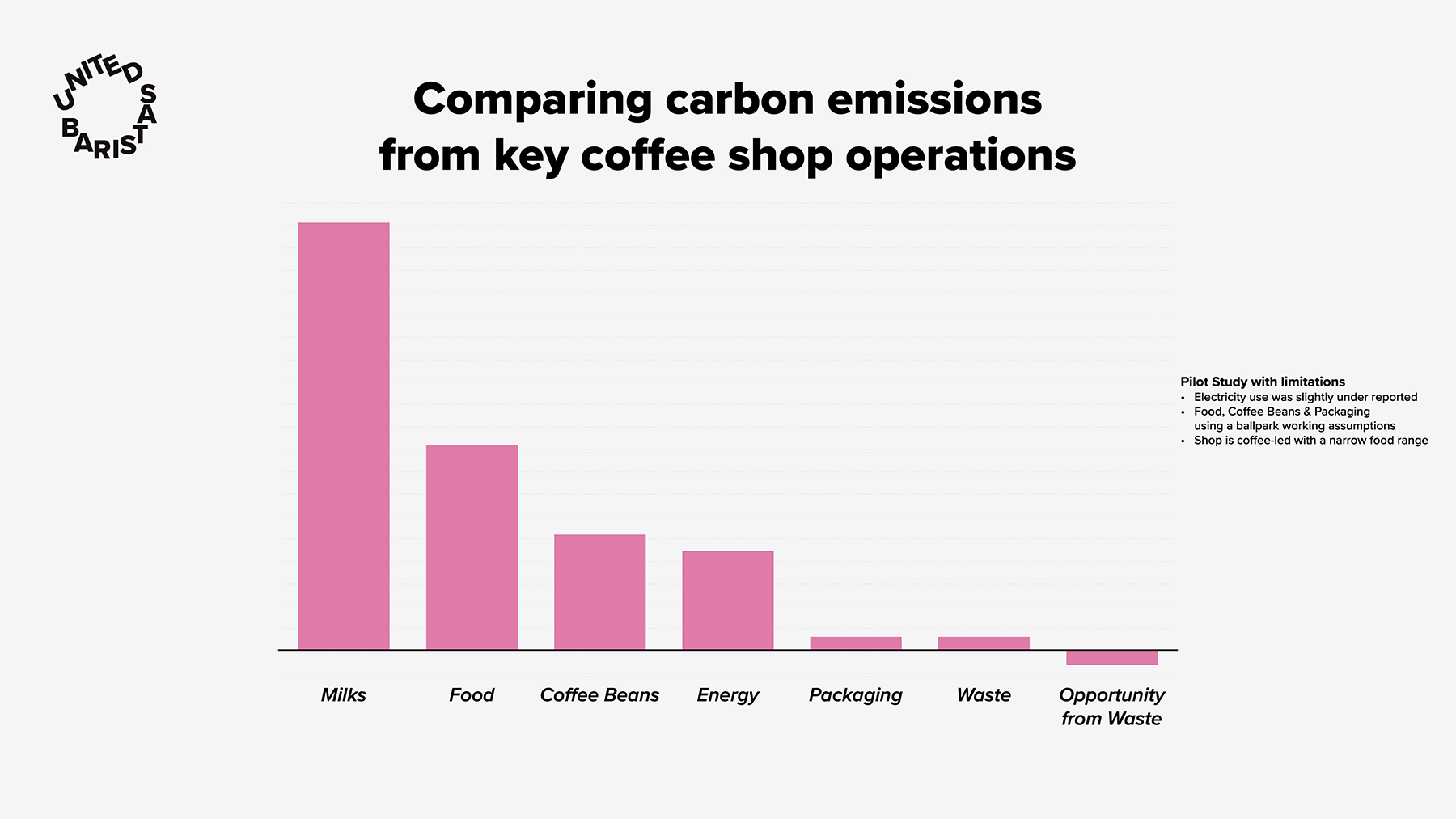
This data was categorised and run through various databases to identify the emissions associated with each of the the shops’ product categories and operations.
The single greatest contributor to both shops’ carbon footprint is milk, followed by food, coffee beans and energy use.
Understanding the causes of a shop’s carbon footprint allows the coffee industry to focus their energy and resources on areas with the greatest potential benefit.
It has become evident that that some of the areas the coffee industry has focused on previously, from cups to packaging to ground coffee, have some of the smallest emissions.
A focus on milk selection and espresso machine electricity consumption is mission-critical
The industry needs to do more comprehensive research on its carbon emissions to better understand where cost-effective carbon reductions can be made. However, the need to reduce greenhouse gas emissions associated with milk selection and espresso machines is clear. By tackling these issues alone, it’s possible to reduce the carbon footprint of a flat white from ~ 250 grams to less than 50 grams.
Coffee-making is a key cause of coffee’s carbon footprint
United Baristas currently estimates typical consumption of ~ 15,000 kWh per year. There’s a new generation of espresso machines that have smaller, more efficient boilers and better heat recovery systems to make them around one-third more efficient.
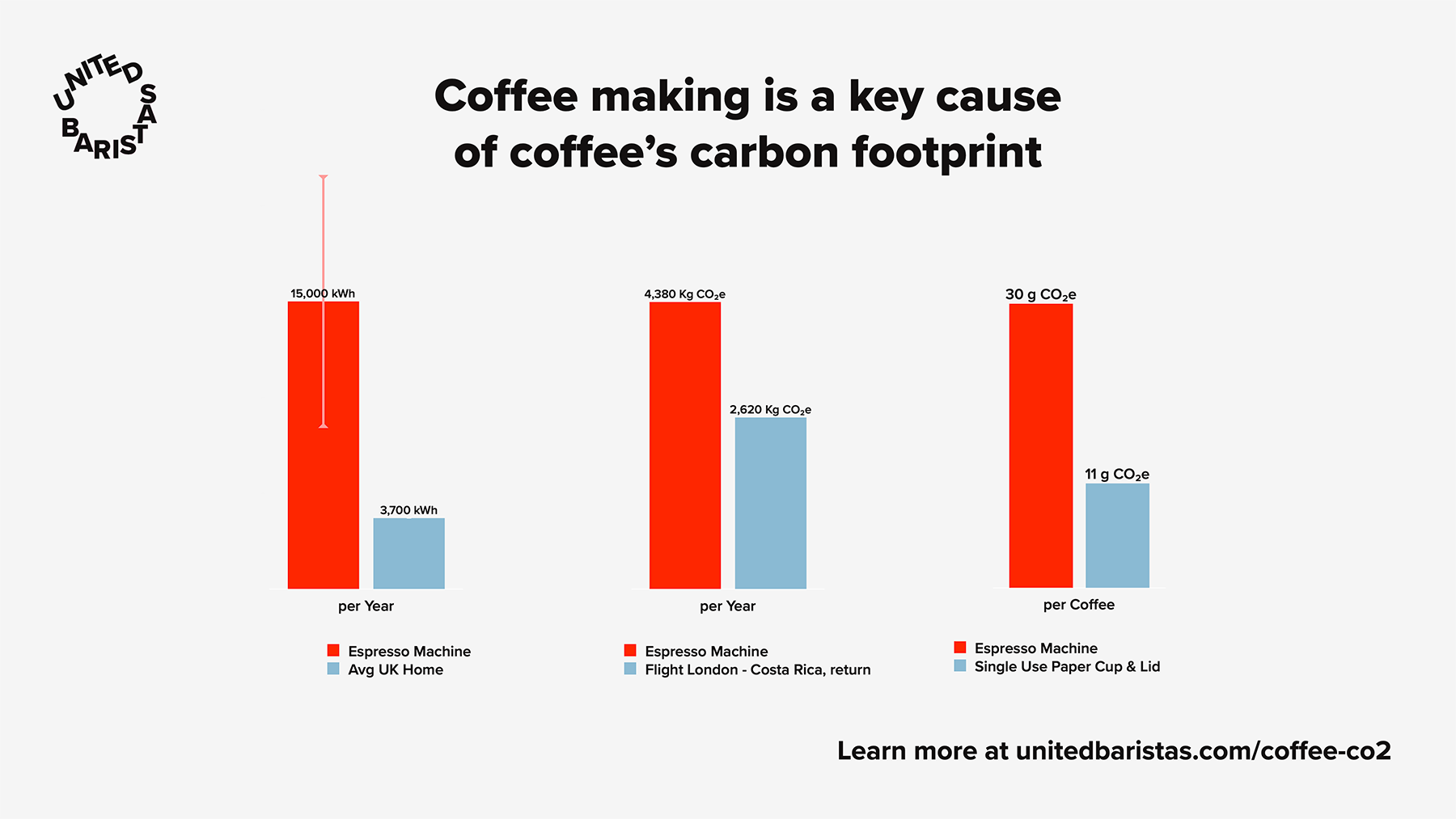
With electricity costs dramatically increasing over 2022, there’s a newfound appreciation of the espresso machine’s energy consumption and associated running costs.
Learn more about the carbon footprint of espresso machines
It’s generally financially prudent for coffee shops to upgrade their espresso machines when the current operational, maintenance and depreciation costs are greater than the cost of running a new machine. Higher electricity costs make upgrading to energy efficient equipment more attractive and UK businesses currently benefit from a super deduction on select capital investments, such as coffee-making equipment.
As is often the case with climate change issues, prudent medium-term viable decisions are often broadly aligned with carbon reduction targets.
Crying over milk
Different types of milk have different carbon footprints. And each type of milk, brand, region and product also have different greenhouse gas impacts.
The carbon footprints of some products are readily available; while for others the information is not published. When specific product information is not available it is necessary to use category averages to make comparisons. As various milks come in a variety of pack sizes, it’s commonplace to compare the carbon footprint per litre of liquid.
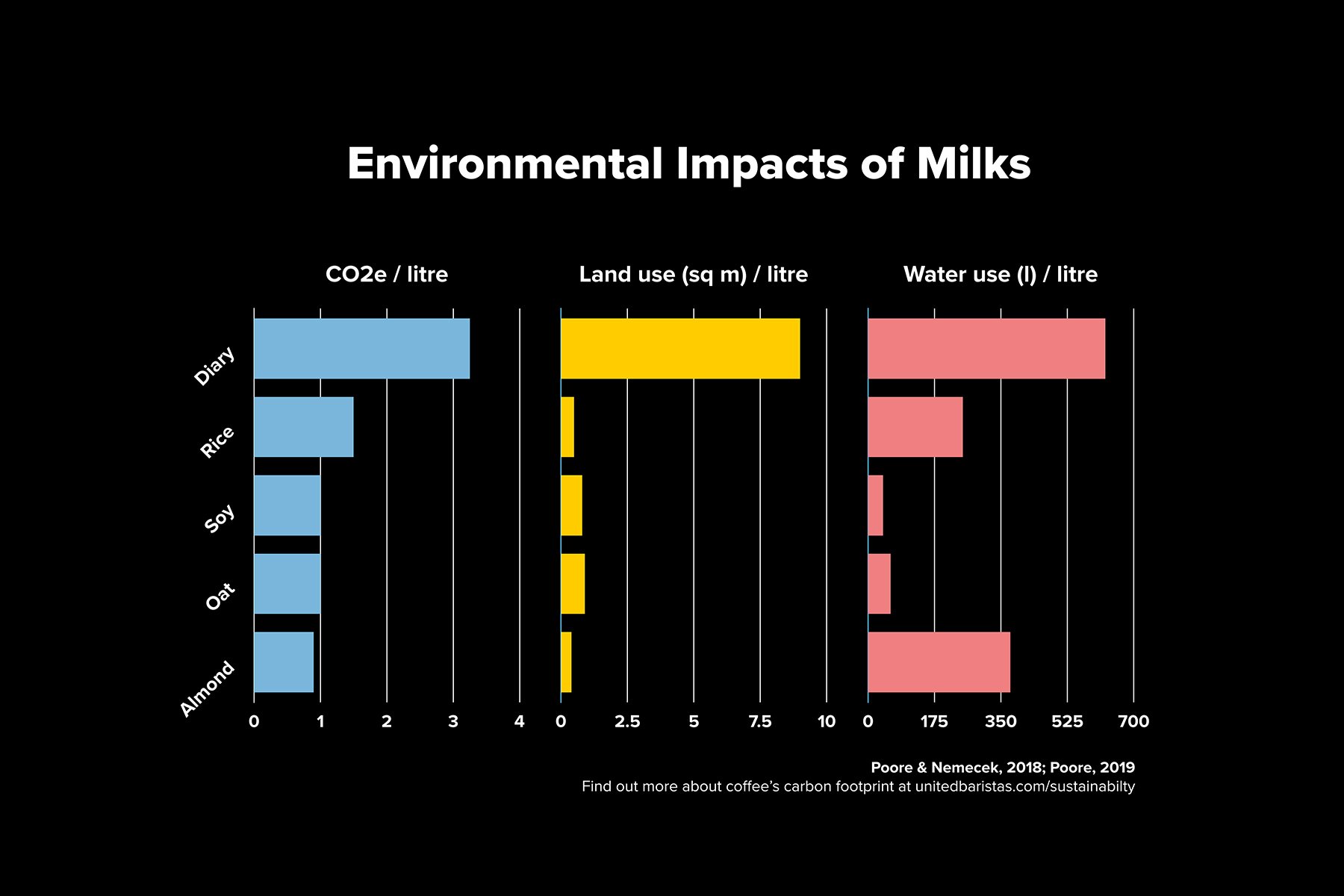
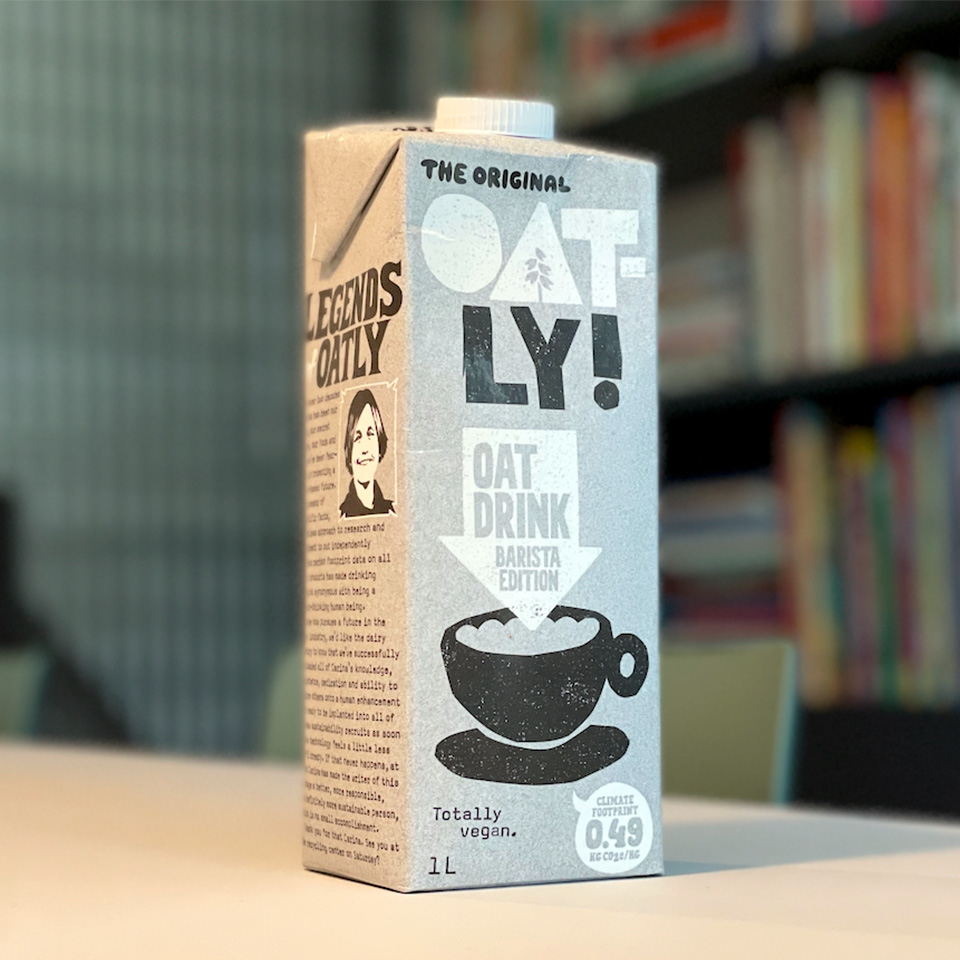
European dairy milk has a carbon footprint about 1.6 Kg per litre. Low methane dairy can be as low as around 1 Kg per litre, which is similar to the global average for oat milk. And the current oat milk leader-of-the-pack Oatly, now has a carbon footprint of 0.49 Kg – up from 0.44 Kg in 2021-22.
Most coffee shops offer dairy milk, oat milk and maybe another alternative, such as almond or soy. Talking with coffee shop owners, oat milk consumption is typically between 15% and 60% for shops offering a range of milks. It has become increasingly apparent to us that the range is correlated with the oat milk surcharge – the lower the surcharge, the higher the share of oat milk.
Shops can typically make a small profit on oat milk with a 20p surcharge and these shops generally see around 40 – 60% of oat milk sales. Of course, some shops have done away with the oat milk surcharge, or only offer oat milk, and these shops have higher oat milk consumption rates again.
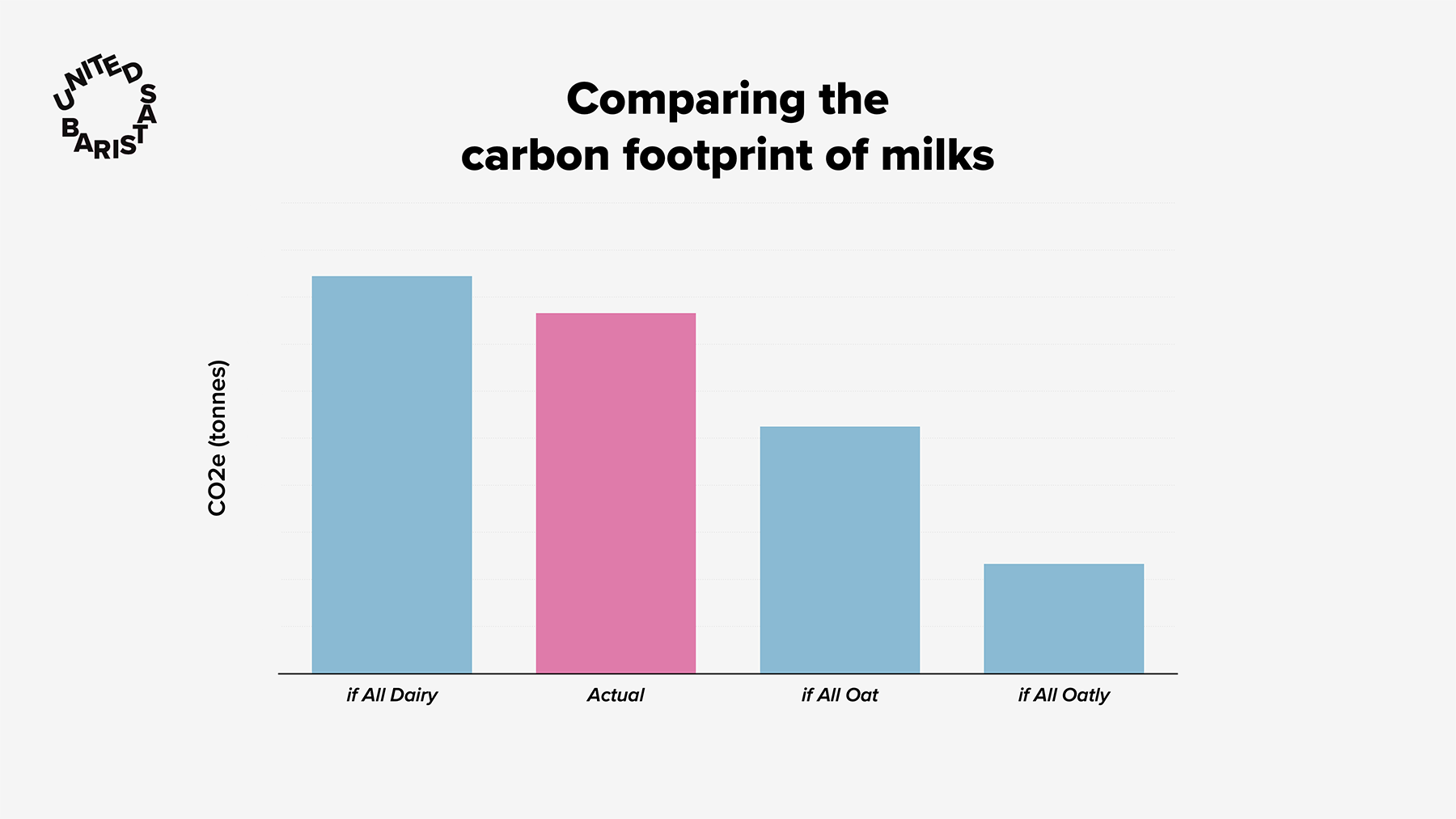
The shops in the pilot study are at the lower end of the range with oat milk usage between 15 and 20%, presumably because the oat milk surcharge was relatively high at 40 – 50 pence.
Any shift from standard dairy to low-methane dairy, to oat, to Oatly has a significant, positive reduction in the shops carbon footprint. In fact, if these shops were to only use Oatly, their carbon footprints would drop by more than 10 tonne. That a massive quantity of greenhouse gas. For context that’s equilivant to the carbon emissions from heating four houses – or more than either shops’ counter-food range footprint.
Of course, there’s also massive benefit to choosing a serve with a smaller quantity of milk. Choosing a flat white over a latte, for example, gives you the same amount of caffeine and can reduce the footprint by as much as 150 grams. There’s even greater benefit if you opt for an espresso or a filter coffee.
A playbook for raising cup prices and reducing the oat milk surcharge
Reducing your shop’s carbon footprint
The pilot study largely confirms what we already knew about reducing coffee’s carbon footprint. And while more research is required to explore some aspects, the causes of emissions the coffee community can focus on is now abundantly clear. We need to start with the main product we sell: cups of coffee.
Now’s a great time to start reducing your shop’s carbon footprint. If you are just starting out, you can get additional background information in our previous articles. And if you are already cutting greenhouse gases, we want to acknowledge your efforts as well as encouraging you to go farther, faster. You’re doing great work.
There’s going to be opportunity for coffee shops to get involved in the coffee shop carbon reduction project in 2023 – so stay on the lookout 👀
As the pilot study shows, our emissions are still too high to prevent catastrophic impacts for coffee producers and, equally, there are relatively easy ways to dramatically cut coffee’s greenhouse gas emissions. Reducing our carbon footprint is coffee’s greatest challenge. In fact, the future of our industry depends on it.