Coffee tasting notes are broken. It’s nearly impossible to choose a coffee based on the descriptors. Everyday drinkers can’t find the coffees they like. Informed consumers can’t make sense of the notes. And baristas are left deciphering three-word phrases with production information.
As a consequence, coffee tasting has gained a reputation for being difficult, subjective or even a hoax. The rot is setting in. Baristas increasingly focus on other skills. Consumers have little expectation of navigating coffee ranges. Some roasters have even given up supplying tasting notes, let alone creating ones that educate and entertain.
This is an unpardonable position for an industry that defines itself on the basis of flavour.
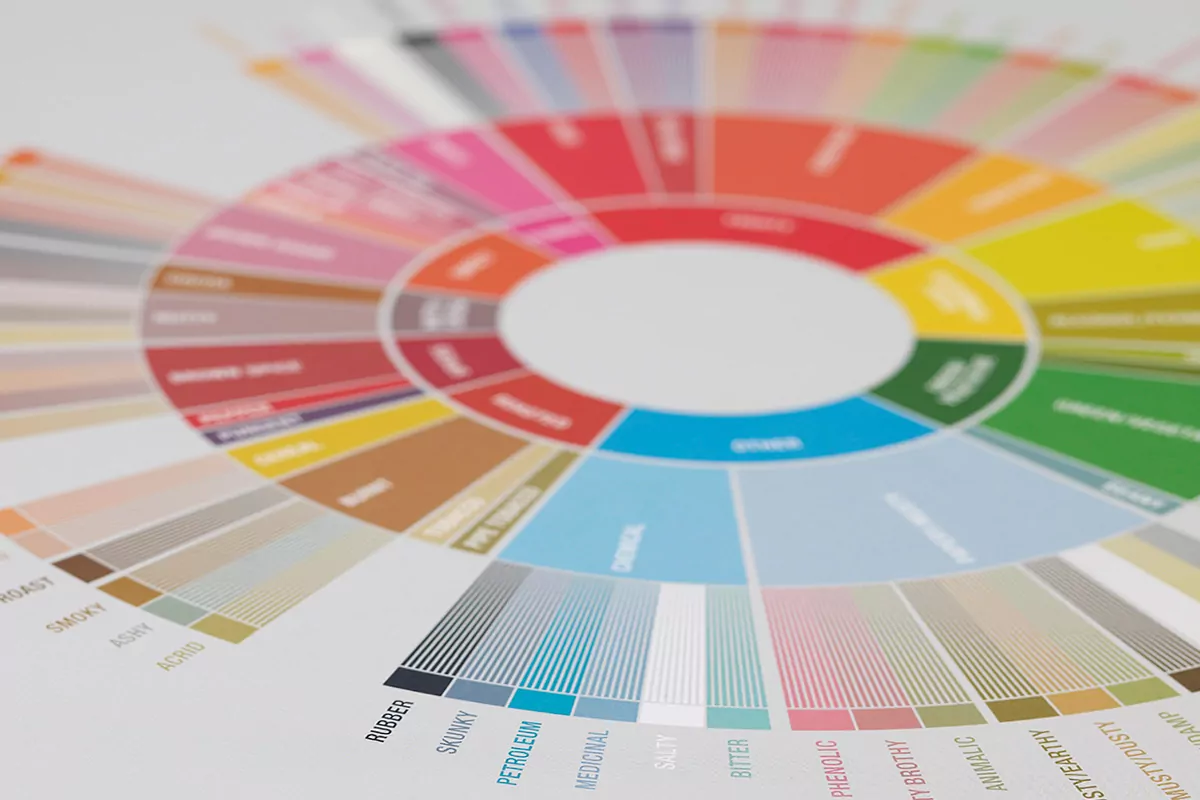
Blame lies with the incoherent SCA Coffee Taster’s Flavour Wheel. It muddles tastes, flavours and aromas to create a confusing system that hinders accuracy and obscures clarity. Worse still, it overlooks other fundamental aspects of coffee tasting.
What’s infuriating about the Coffee Taster’s Flavour Wheel is that it breaks well-established tasting conventions without offering useful distinctions of its own. It also implies that coffee’s flavours are beyond categorisation – they’re not.
The Coffee Tasting Framework
United Baristas wants to kickstart a community-wide conversation on how we can better communicate coffee’s distinctive flavours. Better tasting notes are fundamental for the industry’s viable future. More accurate communication can empower consumers and support specialty coffee’s price premium.
The specialty coffee community needs a new framework that’s accurate, intuitive and grounded in how people actually perceive flavour.
The new Coffee Tasting Framework guides roasters, baristas and consumers through a straightforward process to assess colour, aroma, mouthfeel, taste and flavour. It introduces a new key concept: ‘alignment’. When mouthfeel, taste and flavour align, coffee is easier to appreciate.
The framework achieves three important things. It can:
- explain why some coffees are tastier than others
- match consumers to coffees
- provide the foundation for better tasting notes
To support the assessment process, the framework also includes:
Coffee Aroma Map: 101 key aromas grouped by dominant aromatic compound, plus a method for plotting aromas to appreciate quality.
Coffee Flavour Wheel: A continuous wheel of 73 distinct, natural flavours grouped by family, with adjacent flavours placed side-by-side.
Understanding ‘tasty’ coffee
Despite the wide range of aromas and flavours, most tasty coffees share three traits: a pleasant mouthfeel, harmonious taste balance and strong alignment between taste and flavour.
Obviously, some coffees are tastier than others. Using balance, complexity and alignment, specialty coffees can easily be divided in four grades: good, very good, excellent and outstanding.
Writing tasting notes
Tasting notes are simultaneously marketing copy, a promise to the consumer and a narrative translation of a sensory experience. Strong tasting notes combine accurate descriptors with evocative language.
Roasters and baristas can transform their Coffee Tasting Framework assessment into tasting notes to sell, guide and delight.
Tasting notes are the future of specialty coffee
Specialty coffee is a big tent. There’s room for many flavours, styles and business strategies.
United Baristas wants your business to succeed. Use our tools and framework to craft your own approach to coffee communication.
Specialty coffee has greatly evolved over the past 50 years. But its future still rests on one thing: serving delicious, distinctive coffee.
We think specialty coffee is very, very tasty.
It’s time for a flavour revolution.