


The specialty coffee industry is held back by the quality of tasting notes. Tasting notes should help coffee drinkers identify beans and brews they like.
Unfortunately, flavour descriptions often confuse consumers more than they help. Poor quality tasting notes give the impression that tasting coffee is difficult, subjective or even a hoax. This is an unpardonable position for an industry that defines itself on the basis of flavour.
United Baristas wants to kickstart a community-wide conversation on how we can better communicate coffee’s distinctive flavours. Better tasting notes are fundamental for the industry’s viable future. More accurate communication can empower consumers and support specialty coffee’s price premium.
Developing a Coffee Tasting Framework
Coffee tasting is not subjective, dominant primary aromas and flavours can almost always be agreed upon.
Everyone ‘tastes’ their food and drink, but tasters consider what they’re perceiving in a more structured way. When you have a clear conception of aromas and flavours, it’s easier to identify what is notable and distinctive – and to communicate it more effectively.

Other beverage industries, such as wine, gin and whisky, have developed systems to support tasters as they prepare tasting notes. In the next article of this series, we offer practical suggestions for how a new coffee tasting framework might be developed. Appreciating that some will see this as an unnecessary reinvention of the wheel, we begin with an overview of a tasting assessment and explain why the Specialty Coffee Association’s Coffee Taster’s Flavour Wheel is fundamentally broken.
To be absolutely clear, we see the specialty coffee industry as in need of a flavour communications revolution.
Why the SCA’s Coffee Taster’s Flavour Wheel doesn’t work
There are multiple, interconnected shortcomings with the Coffee Taster’s Flavour Wheel. But let’s start with the obvious: it isn’t a wheel at all.
The current iteration is far removed from earlier versions and was presumably inspired by Niki Segnit’s excellent flavour wheel in The Flavour Thesaurus. Segnit’s wheel is elegant because it neatly categorises adjacent flavours to help readers pair new and tasty combinations.
By contrast, the Coffee Taster’s Flavour Wheel is a list of notes grouped into nine categories, then plotted in a circle. Unlike Segnit’s wheel, gaps appear where flavours are discontinuous. Its structure prioritises style over substance.
It also attempts to do too much. The Taster’s Wheel muddles tastes, flavours and aromas, creating a confusing framework that hinders accuracy and obscures clarity. It also overlooks other fundamental aspects of tasting.
Understanding good taste
There are just five basic tastes: sweetness, sourness, bitterness, saltiness and umami. These attributes are detected on the tongue.
Delicious food and drink achieves a harmonious and balanced perception of these components. Two or more tastes are required to create balance. For example, granulated sugar isn’t balanced, it is only sweet. But sweet sugar can balance bitter black coffee. Most specialty coffees have lower bitterness, so finer grades typically achieve balance between sweetness and sourness.
Harmonious balance is lip-smackingly tasty. Acids are present in all coffees and perceived as sour. The best coffees typically balance sourness, sweetness and bitterness. Saltiness is rare. Umami is becoming more common with the increasing popularity of fermentation processing methods.
The principle of balance also applies to food pairings. For example, pairing a salty-sweet croissant with black bitter coffee and sugar is a classic combination. All traditional coffee pairings achieve a balance of the basic tastes. Even combinations that may appear unusual from a European viewpoint – like adding salt and ghee to bitter coffee in the Ethiopian coffee ceremony – make excellent sensory sense.
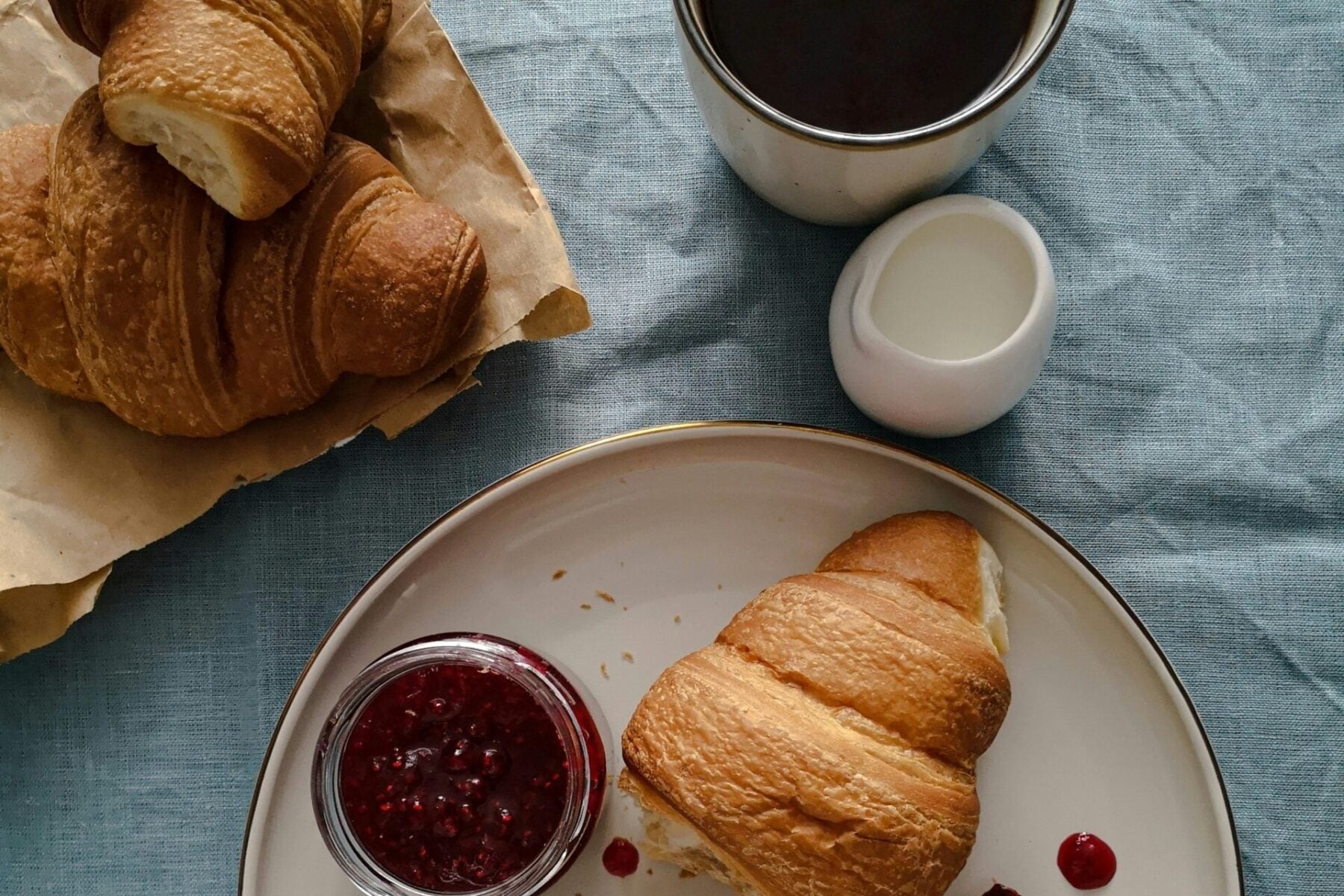
It’s possible to pair coffee with food in countless ways. The key is that each taste should be proportionate. Too much sugar makes coffee overwhelmingly sweet or the lower bitterness of some specialty coffees means they don’t always pair well with sweet, salty viennoiserie.
Balance can occur within a single item or between multiple items. It’s often easier to pair items with complementary tastes than it is to pair two items that are already individually well-balanced.
One of the ways specialty coffee differs from commodity coffee is that it seeks internal balance. Commodity coffee is often used as a bitter counterweight to sweet foods, such as chocolate, biscuits, tiramisu or brandy. Specialty coffees are usually designed to be drunk alone and the industry’s conception of quality is based on this starting point. Whether this is appropriate is up for future debate. Wine, for instance, is often produced with food pairings in mind. A coffee designed to pair with a chocolate biscuit, for example, is unlikely to score highly even if the pairing is delicious.
Much of a coffee’s tastiness comes down to how well it balances the basic tastes. A useful rule of thumb is that good coffees balance at least two tastes; great coffees balance at least three.
Identifying flavours
Flavours are perceived when aromas rise from the mouth into the nasal cavity
Flavour is distinct from taste, but alignment between the two makes for tastiness. For instance, all sugar is sweet, but brown sugar has a unique flavour. Or, raspberries combine specific flavours with sourness and sweetness.

The Coffee Taster’s Flavour Wheel occasionally nods to this relationship. For example, ‘sweet’ is a parent-category with ‘brown sugar’ beneath it. But the logic is inconsistent. ‘Sour’ is listed as a child-category. And ‘bitter’ and ‘salty’ are on the outer rim with no child flavours, despite many of the wheel’s flavours having bitter or saline properties.
Sourness is particularly confusing. It was merged with ‘ferment’ to create a parent category. While fermentation can increase both acidity and sweetness, this creates odd outcomes such as the inclusion of ‘overripe’ – a tasting note surely defined by its sweetness more than its sourness. Furthermore, many of the pleasant sour flavours are categorised elsewhere on the wheel.
Simply put, the wheel attempts to do too much. It’s titled a flavour wheel, but includes the four basic tastes and sometimes uses them to group flavours. However, since almost all natural flavours combine multiple tastes, this approach is doomed to fail.
These flaws become glaringly obvious at the outer rim. Many flavours are discontinuous. Should ‘caramelised’ really be between honey and maple syrup? Should ‘dark chocolate’ sit next to them, despite being largely defined by its bitterness? Especially since the subsequent flavour is ‘chocolate’, which is cocoa solids sweetened with sugar.
The tier system is also inconsistent. Some categories have two tiers, others three. ‘Pipe tobacco’ isn’t next to ‘ashy’ or ‘smokey’ and sits on a different tier. Categories like ‘green/vegetative’ and ‘nutty-cocoa’ have three tiers only because they have duplicated sub-categories. But maybe the most outrageously inconsistent use of the tiers is the parent category named ‘other’.
These inconsistencies leave gaps. Sometimes they’re filled with vague terms like ‘dark green’ (which is, apparently, canned vegetables) or ‘fresh’ (specified as the aroma of cut grass), which can’t really be described as flavours. Other times, the space between two notes – like between ‘overripe’ and ‘under-ripe’ – is used to mask the fact that the notes aren’t actually perceived as adjacent.
Finally, the wheel includes off-flavours such as ‘mouldy’, ‘stale’ and ‘acrid’ which are widely considered as faults. These terms are suitable for grading; but specialty-grade coffees with these attributes probably shouldn’t be sold to consumers. The terms, however, appear on consumer-facing packaging.
In short, the Coffee Taster’s Flavour Wheel muddles how we conceptualise coffee’s flavours – and hampers our ability to communicate them.
Exploring aromas
Aromas can be perceived without drinking. They travel from the cup through the nose and into the nasal cavity – the same place where flavours are identified.
While aroma and flavour share qualities, they are physiologically distinct. Orthonasal aroma notes come from sniffing. Retronasal flavour notes come from tasting. The Taster’s Wheel ignores this distinction, it includes ‘floral’ as a flavour category for example.
This lack of clarity further jumbles tasting notes and contributes to confusing coffee communications.
One of the qualities that makes coffee beguiling is its aromas and flavours are often noticeably different; more so than other food and drink items. We’ll unpack the importance of aroma in the next article of the series. In it, we introduce a new tool to help tasters identify and understand harmonious aromatic combinations.
Other building blocks of good tasting notes
Before you take a sip, you’re already drinking with your eyes. So powerful is our visual sense that we often categorise food seen on TV or social media as delicious.
Closely observe filter coffee and you’ll see that some are reddish-brown, others greenish-brown and still others yellowish-brown. Colour and transparency can hint at origin, acidity and roast level; however, it’s most closely correlated with ‘mouthfeel’.
Many tasting frameworks break mouthfeel into two components. ‘Weight’ is the perception of the heaviness of the liquid in your mouth. Specifically, is it light, medium or heavy. The weight is often described as ‘body’, for example, this coffee has a ‘medium body’.
The second component is texture. Only some coffees have a notable texture, for example there might be an effervescent effect, despite the coffee not being carbonated. Some common pleasant textures include silky and viscous. Texture has little to do with ‘weight’, taste or flavour, but is a key characteristic of many delicious coffees.
Probably the most miscommunicated coffee mouthfeel descriptor is astringency, which is quite common especially in lower-quality coffees. This is the texture associated with a drying of your mouth (try eating a teaspoon of unsweetened cocoa powder). But because this concept is missing from the SCA’s wheel, many baristas mistakenly describe these coffees as ‘dry’.
The term dry comes from wine and means not-sweet. It has nothing to do with mouthfeel. For example, wines are placed on a scale from dry to sweet. When coffee co-opts language from other beverages it should use the terms faithfully to avoid confusion.
A tasting revolution
Our plea is for specialty coffee to stop using the Taster’s Flavour Wheel for tasting notes. Using it causes more harm than good. Stop buying copies of the poster for your coffee shop, cease putting printouts in front of consumers at tastings, and please for the love of all things delicious start to categorise aroma, mouthfeel, taste and flavour.
What’s most infuriating about the Coffee Taster’s Flavour Wheel is that it breaks well-established tasting conventions without offering useful distinctions of its own. It also implies that coffee’s flavours are beyond categorisation – they’re not.
In the next article, we introduce three tools for assessing coffees so you can better communicate each coffee’s distinctive characteristics.
Coffee Tasting Framework: A guide for assessing colour, aroma, mouthfeel, taste and flavour – plus evaluating tastiness based on mouthfeel, balance, ‘alignment’ and complexity.
Coffee Aroma Map: 101 key aromas grouped by dominant aromatic compound, plus a method for plotting aromas to appreciate quality.
Coffee Flavour Wheel: A continuous wheel of 73 distinct, natural flavours grouped by family, with adjacent flavours placed side-by-side.
Despite all the possible aroma and flavour combinations, tasty coffees commonly share three traits: a pleasant mouthfeel, harmonious taste balance and strong alignment between taste and flavour.
Together, these tools can equip tasters and communicators to write better tasting notes. So grab yourself a coffee and let’s get started.
It’s time to get back to basics. Specialty coffee should be tasty.